
Some new perspectives. Some long-standing questions. Here's what's on my reading radar for the second half of 2026.
I’m continuing to try and be more intentional with sharing my quarterly reads to share what’s interesting to be, foster conversation, and source new recommendation. Not just what I've finished, but what I'm curious about and still on the list, what ideas I want to explore, and what perspectives might challenge the way I think about people, teams, leadership, and the experiences we create at work.
For Q3 and Q4, I'm leaning into a slightly different mix of books. Leadership and organizational culture are still very much on the list, but I'm also exploring psychology, creativity/art, human connection, and the value of thinking differently.
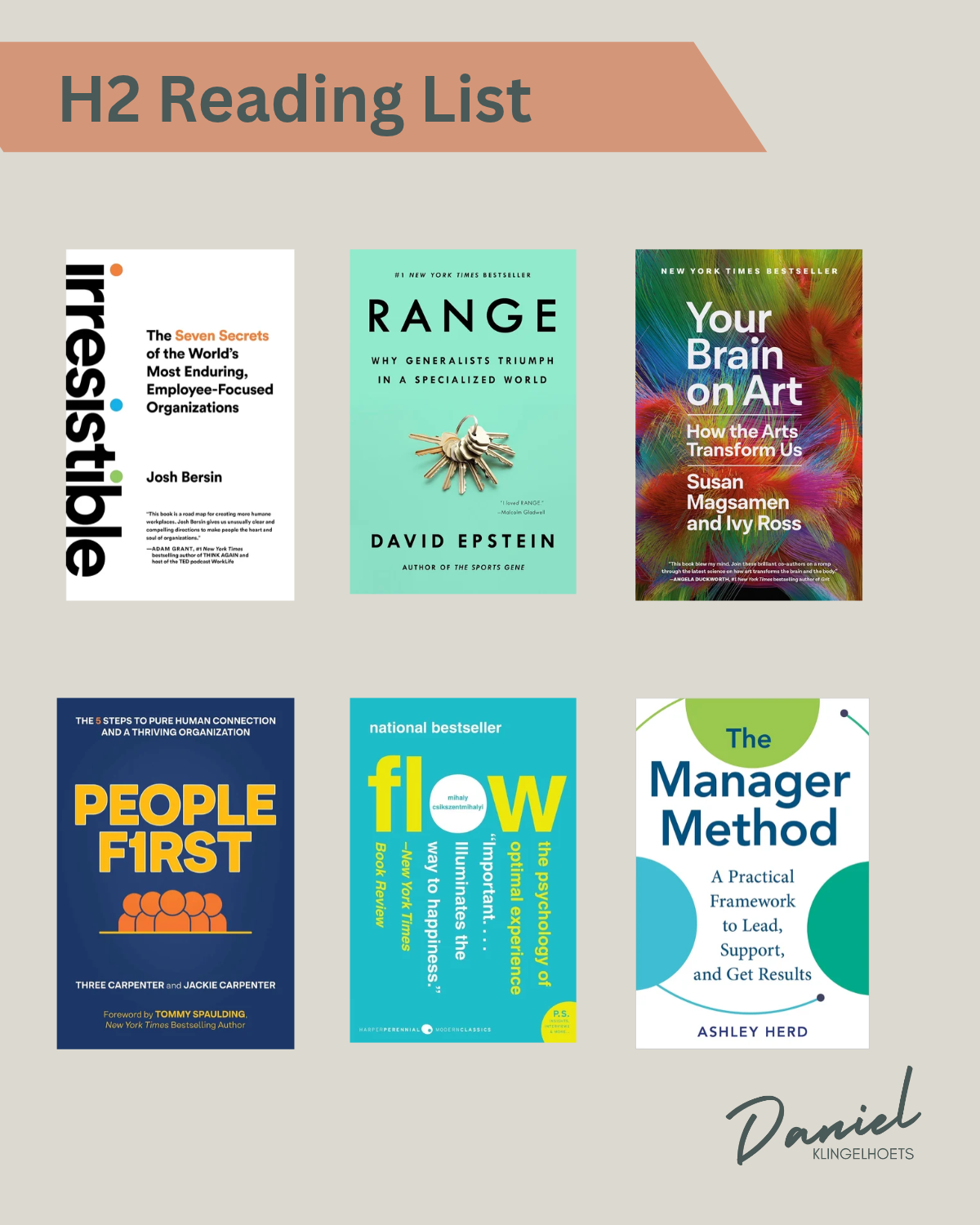
Here are six books currently on my radar and making their way into my reading rotation.
This post includes affiliate links. As an Amazon Associate, this site may earn from qualifying purchases.
The Manager Method: A Practical Framework to Lead, Support, and Get Results
Ashley Herd
I have followed Ashley on Instagram (@mangermethod) for awhile now, and enjoy her perspective, skits, and practical advice to HR and leadership in the workplace. So, when she released her book, I knew I had to jump on it.
Managers have one of the biggest influences on the employee experience, yet we're often quick to promote people into leadership positions without giving them the tools, confidence, or support to actually lead.
That's what caught my attention about The Manager Method. Ashley Herd introduces a practical framework designed to help managers navigate the everyday challenges of leadership with more intention, rather than simply reacting to whatever lands on their desk.
I'm particularly interested in the practical side of this book. From navigating difficult conversations to setting expectations and building trust, so much of the employee experience is shaped in the everyday moments between managers and their teams, and we know more often employees leave bad managers, not the organization.
For anyone working in talent development, HR, or leadership development, there’s simple and organized insight in this one and a helpful reminder: developing better managers isn't just about teaching leadership skills. It's about equipping people to create better experiences for the people they lead.
Irresistible: The Seven Secrets of the World's Most Enduring, Employee-Focused Organizations
Josh Bersin
I’ve been carrying around this one in my backpack all week, picking it up whenever I can. Employee experience is one of those topics that can quickly become a collection of initiatives, programs, and buzzwords. But what does it actually look like when an organization puts people at the center of how it operates?
Josh Bersin explores this question through seven principles for building enduring, employee-focused organizations. Drawing on research and organizational practices, the book examines how leadership, organizational design, employee development, and culture contribute to business performance.
This one is especially interesting to me because of the connection between employee experience and organizational strategy. We spend a lot of time talking about engagement, retention, and culture, but those things don't happen in isolation. They're shaped by the systems, decisions, and everyday behaviors that define how an organization works.
I'm looking forward to exploring how organizations can move beyond talking about being people-first and actually build the conditions that make it true, and sticking to them. The examples from companies shared seem aspirational, but I hope to give some of them a try and challenge how we think differently at work.
Flow: The Psychology of Optimal Experience
Mihaly Csikszentmihalyi
What makes an experience so engaging that you completely lose track of time?
That's the question at the heart of Flow, which explores the psychology behind what the author calls an optimal experience: a state of deep concentration, involvement, and enjoyment in an activity.
There's something powerful about creating the conditions where people become fully immersed in what they're doing. Whether its for ourselves and how we get the most out of our work, projects, productivity, or the workshops and experiences we’re curating for employees as part of their growth and lifecycle journey.
I'm curious to explore how the principles of flow translate into the workplace. What makes work feel meaningful? How do we create opportunities for people to use their strengths, stretch their abilities, and experience a genuine sense of accomplishment?
I suspect this one will offer plenty to think about beyond the workplace, too.
Range: Why Generalists Triumph in a Specialized World
David Epstein
This one came recommended to me by a facilitator while taking a certification course, as the group got into a discussion around cultural dimensions and influence of various roles in the workplace. I've always been drawn to the idea that some of our best ideas come from connecting things that don't necessarily belong together. One of my strengths is “Arranger” after all, and I find energy in the breadth of reach and experiences I’ve had to weave the different threads together for the end result.
Range challenges the conventional wisdom that success comes from specializing early, focusing narrowly, and developing expertise in one particular area. David Epstein makes the case that broad experiences, experimentation, and exposure to different disciplines can create an advantage, particularly in complex and unpredictable environments. He leans in early to set the stage with key examples of the career differences of professional athletes and other figures.
This one resonates with how I think about my own professional journey. I’m still finding where I belong and fit. My work has touched, social impact, talent management, employee experience, facilitation, learning, and team development. While those areas might seem like different disciplines, I find that some of the most interesting projects emerge where they overlap, and I can connect elements of each for more meaningful work.
A good reminder that sometimes the most valuable thing we bring to a room is a perspective that wasn't already in it.
Your Brain on Art: How the Arts Transform Us
Susan Magsamen & Ivy Ross
This might be the most unexpected addition to my reading list, but it's also one I'm particularly excited about. It just came as a recommendation from a coworker and I immediately was intrigued.
Your Brain on Art explores the science behind how artistic experiences influence our brains, bodies, well-being, learning, and connection. From music and movement to visual arts and creative expression, the authors make the case that art isn't simply entertainment or an extra in our lives. It's an important part of how we experience the world.
I have yet to dive in at the time of this post, but I’m excited to learn and identify any connection between this topic and the work of creating meaningful experiences for people.
As someone who enjoys facilitation, experiential learning, and bringing people together, I'm always thinking about how we can move beyond simply delivering information. How do we create something people feel, remember, and carry with them?
I'm curious about what the science of creativity and the arts can teach us about learning, connection, and designing experiences that stick.
People First: The 5 Steps to Pure Human Connection and a Thriving Organization
Three and Jackie Carpenter
If there's one phrase that seems to show up in just about every conversation about organizational culture, it's "people first."
But what does that actually mean in practice?
This is an easy, but practical, read that covers a five-step approach to building human connection and creating thriving organizations. Drawing on their experience in hospitality, the authors focus on the relationship between how organizations treat their employees and the experiences those employees create for others.
We often have so much emphasis on customer or guest experience, but what if we made that same effort on our own people? The two are often discussed as separate priorities, but the reality is that the experiences we create for customers are influenced by the experiences we create for the people delivering them.
This is especially relevant when thinking about the entire employee lifecycle where every interaction is an opportunity to build connection and reinforce what an organization stands for.
I'm looking forward to exploring the practical steps behind making a people-first philosophy something employees actually experience, rather than simply something organizations say.
Final Thought
Looking across these six books, there's a common thread that AI helped me derive: how do we create the conditions for people to thrive?
Whether we're talking about better managers, more intentional organizations, deeper engagement, broader perspectives, creativity, or human connection, each of these topics offers another lens through which to understand the human experience.
It's about collecting ideas, hearing real-life examples from organizations and personal experiences, challenging assumptions, making unexpected connections, and finding small ways to put those ideas into practice.
I'm sure there will be a few notes, highlighted passages, and new ideas making their way into my work along the way.
